I'm a retired guy who found his way into working with copper — partly out of curiosity, partly from seeing what others were creating, and eventually because I enjoyed the process itself. What you’ll find here is what I’ve gathered along the way: a bit of history, some material science, a few things that are harder to put into words, and my own observations from spending time with the metal. Take it in whatever way is useful to you.
Copper through history
Copper is one of the oldest materials humans ever worked with. We're talking 10,000 years or more — archaeologists have found copper beads that old, small simple things that you can just imagine someone making with their hands and a bit of fire. Long before iron, long before steel, there was copper.
What strikes me about it is that across almost every culture you look at, copper was never treated as just a material. It was treated as something that responded. It changed color with the wearer, it took on heat, it held the marks of whoever shaped it. You find it in Egypt for ritual tools and sacred vessels, in Mesopotamia for ceremonial blades, linked to Venus and Aphrodite in Greece and Rome, used by Indigenous North Americans for adornment, in Asia for bells and bowls, in medieval Europe in healing salves. Everywhere it shows up, people treated copper as something alive — something that participated rather than just sat there.
The Royal Cubit
One thing that pulled me deep into this was learning about the ancient Egyptian Royal Cubit — the Mahe. It's a unit of measurement based on the human body, specifically the distance from the elbow to the tip of the middle finger. You can see it used in the architecture of the Step Pyramid of Djoser, which goes back to around 2700 BCE.
It wasn't just a practical measuring tool. Some researchers have found that the Sacred Cubit lines up with a resonant frequency around 144 MHz, which is associated with light. There are also suggested mathematical relationships to one ten-millionth of Earth's polar radius, and to geometric ratios in the hydrogen atom. I can't fully verify all of that, but the pattern is interesting enough that I've kept it in my research. The basic point is that ancient measurement systems seem to have been attempts to align human craft with the structure of the natural world — whether you take that literally or symbolically.
Slim Spurling and tensor rings
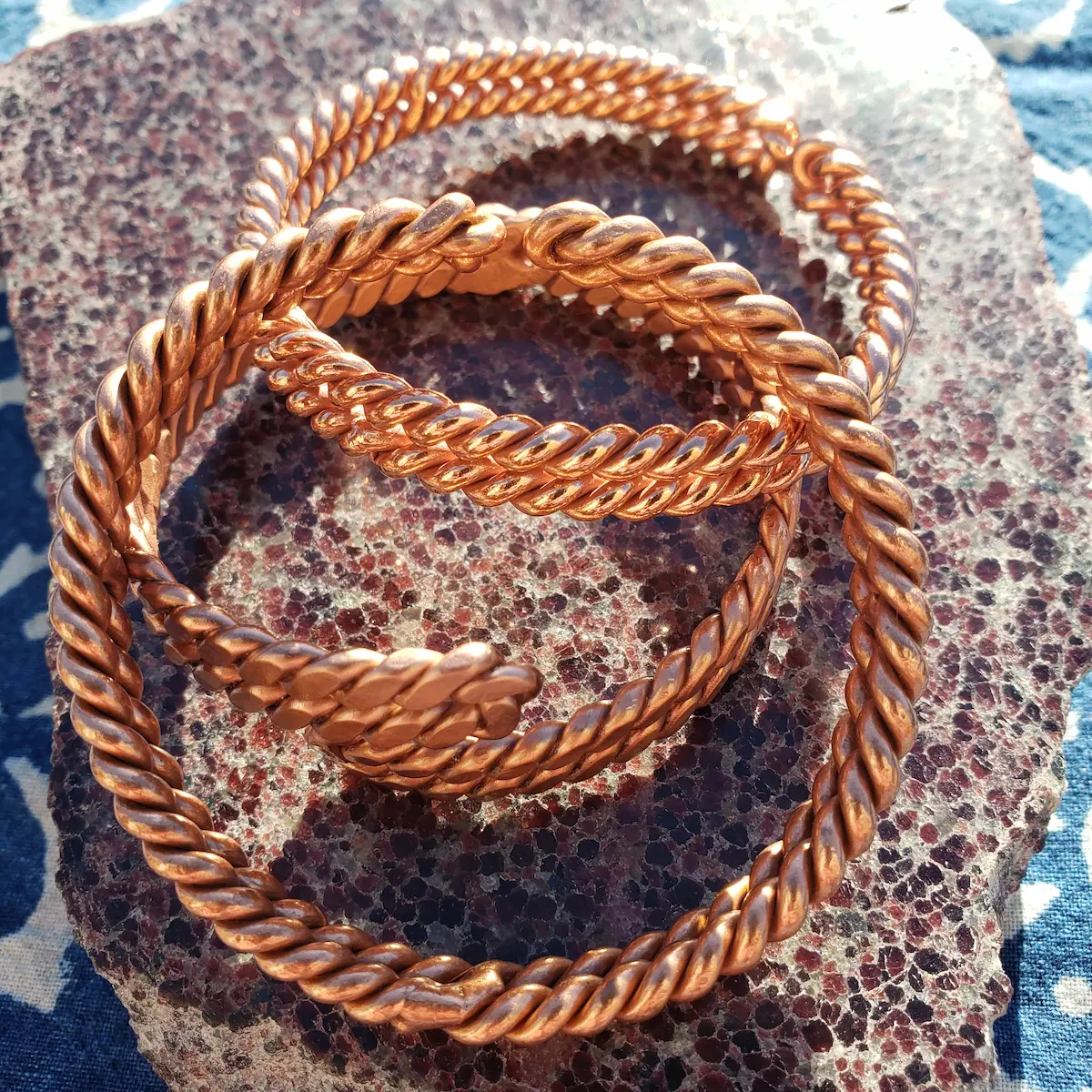
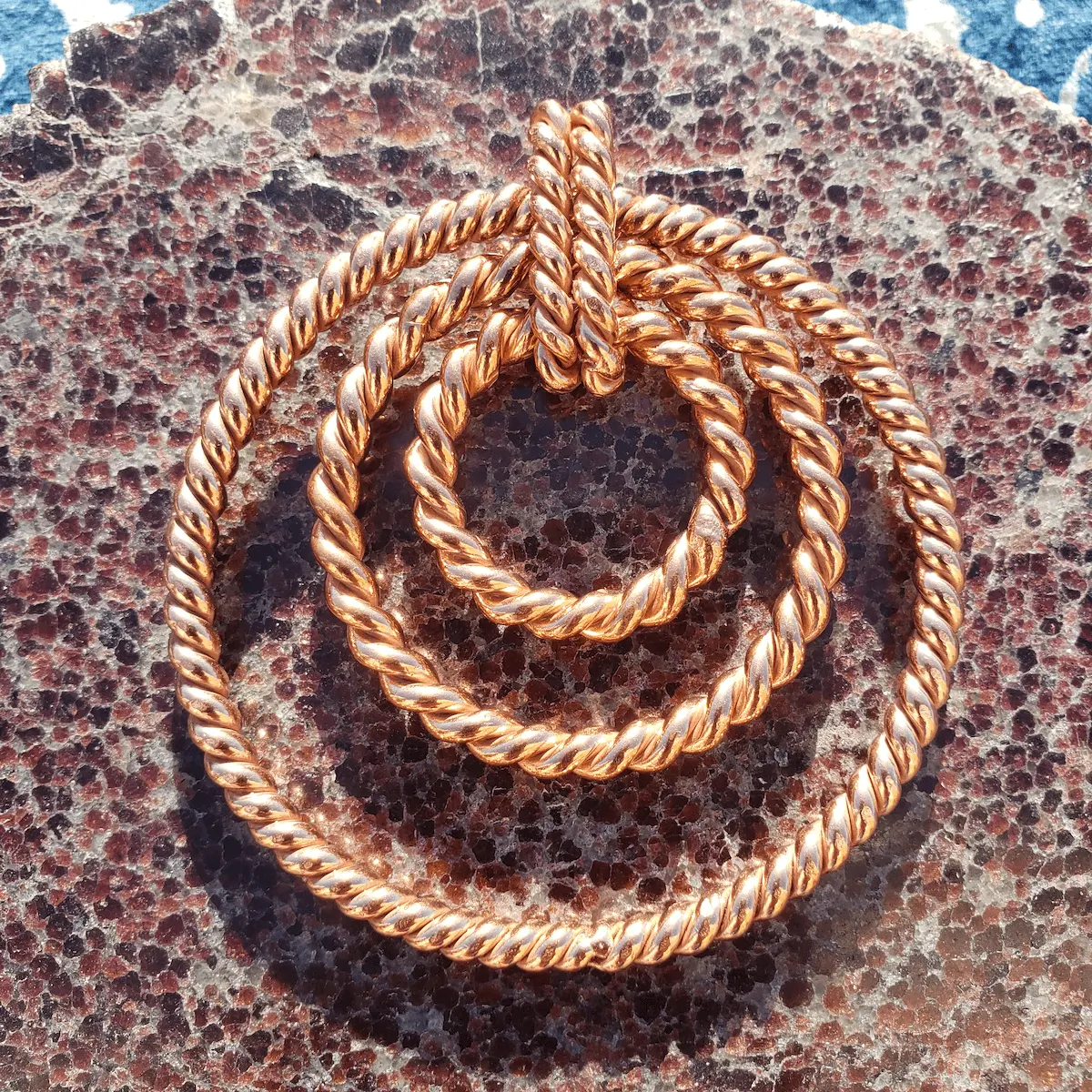
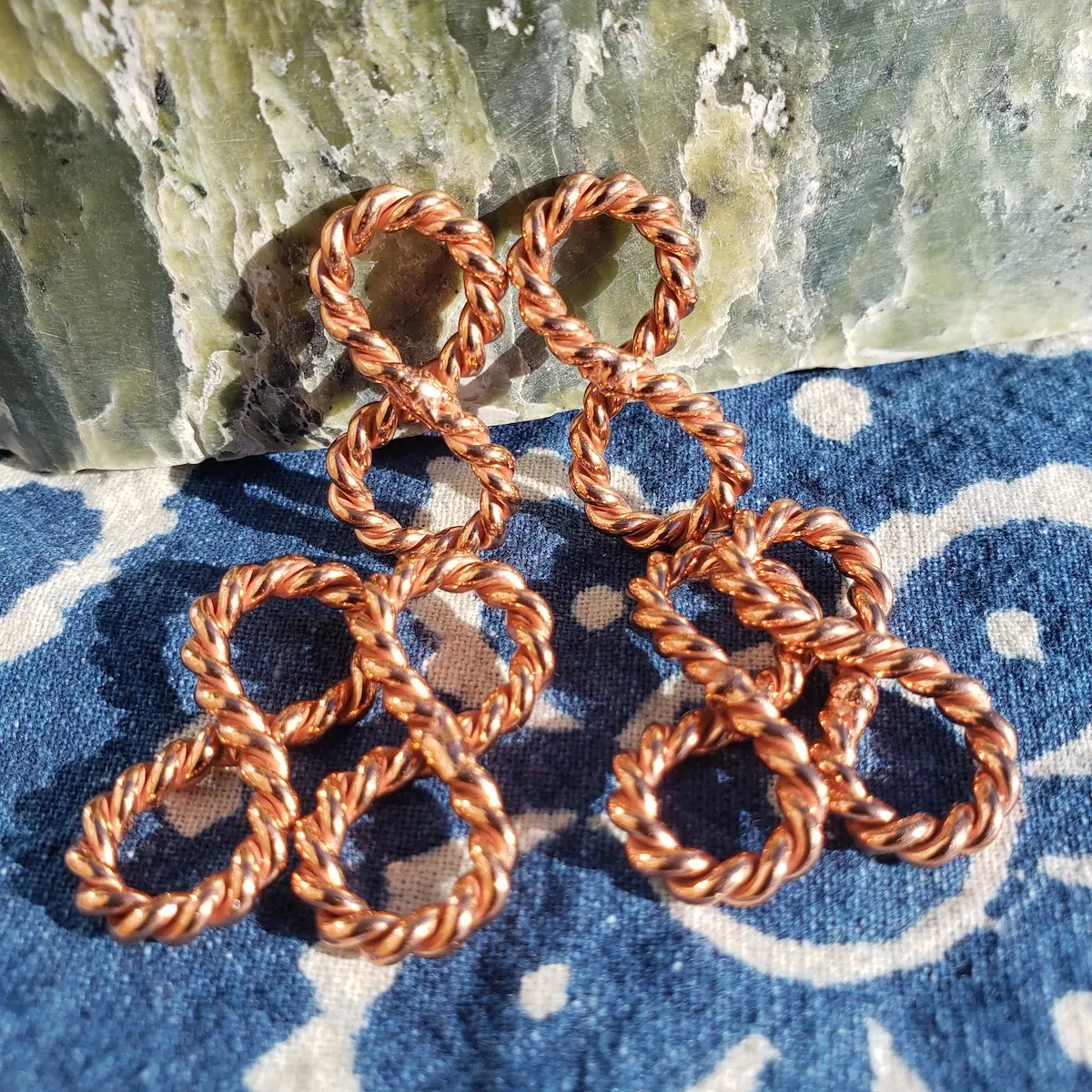
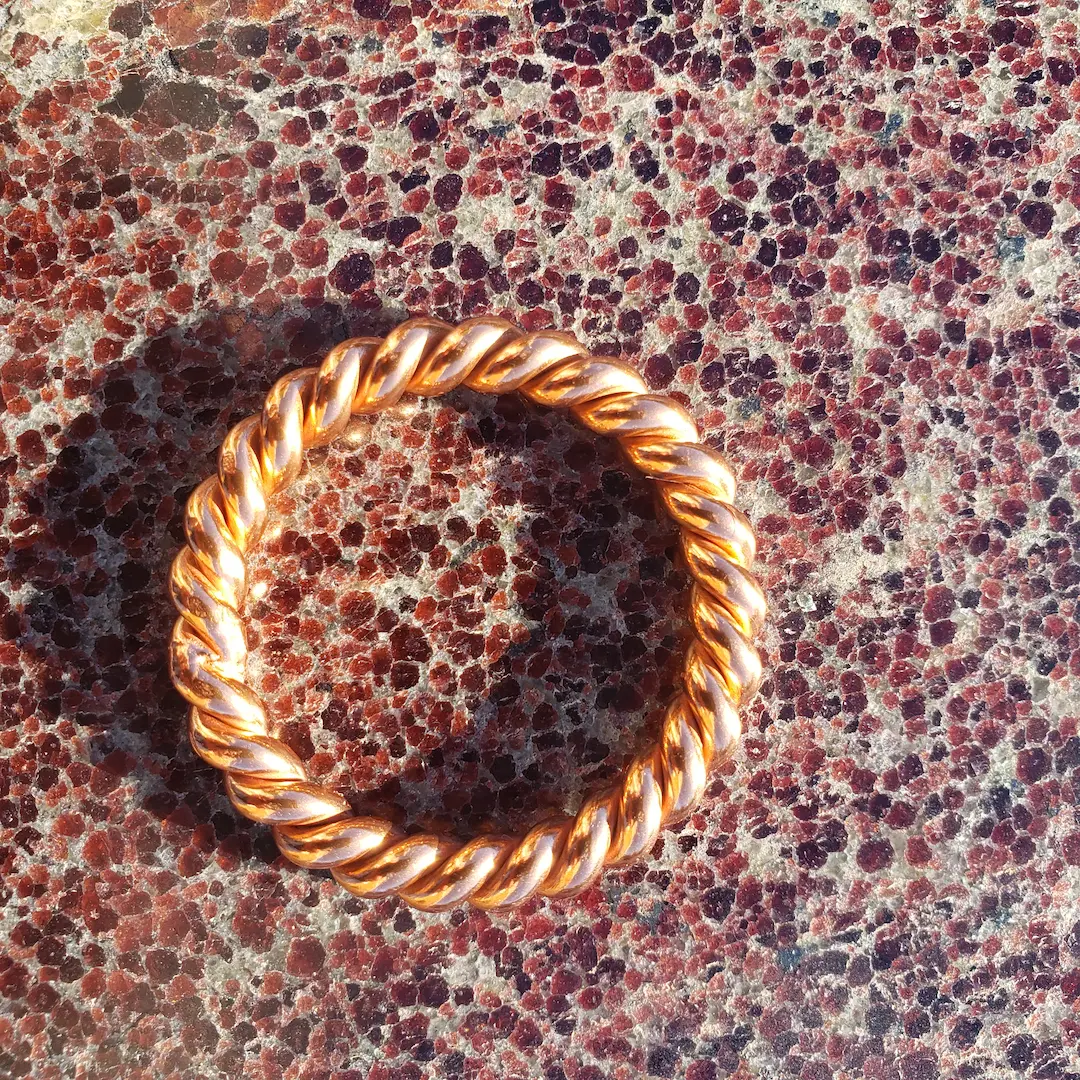
Slim Spurling (1938–2007) was a blacksmith and dowser who spent years researching how copper interacts with geometry and what he called subtle energy. In 1991 he discovered what he called the Light-Life Ring — the first tensor ring. From there came the Acu-Vac Coil, the Feedback Loop, and the Harmonizer. The basic idea is that copper wire made to a specific length, twisted in a consistent direction, and formed into a closed loop creates a coherent energetic field. Whether you take that literally or just as an interesting principle, the craft point underneath it is real enough: precision matters. The length, the twist, the closure — none of it is arbitrary.
The lengths Spurling used were all derived from the Royal Cubit — fractions and multiples: 1/8, 1/4, 1/2, a full cubit. This is what I base my own bracelet measurements on, which is part of why I find the whole thread interesting — it connects something I'm making on my workbench directly back to the same proportions the Egyptians were using 4,000 years ago. He also put a lot of emphasis on twist direction, right-hand being expansive and left-hand contractive, which is something I've started paying attention to in my own work too.
The science of the material
Setting aside the energetic side of things for a moment — copper is also just a remarkable material on its own terms. It's one of the most electrically and thermally conductive metals we know of, which is why it warms the instant it touches skin. It reacts with oxygen, sweat, and skin oils to develop a patina that is completely unique to whoever is wearing it — it literally records your chemistry over time. It naturally inhibits microbial growth, which is well documented and part of why it was historically used for water vessels and medical tools. And it's soft enough to shape by hand but durable enough to hold its form, keeping the marks of the maker built right into it.
My own observations
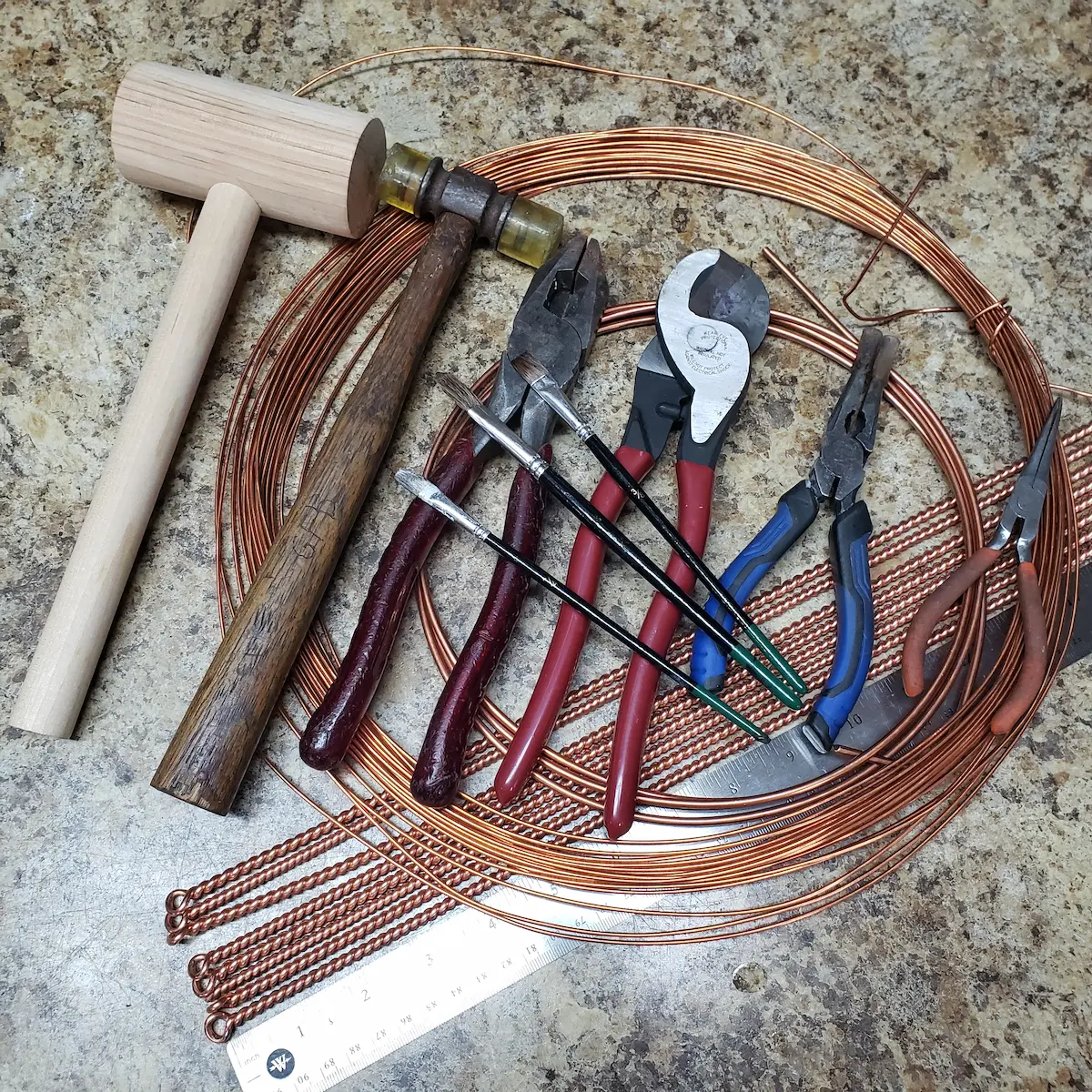
Only been at this about a year so I'm still figuring things out. A few things I've noticed: the first twist really does seem to set the character of a piece. The copper behaves a bit differently depending on the day — temperature and humidity seem to matter. Each finished piece ends up with its own personality even when I'm trying to make them consistent. But at the end of the day, hand crafting does make things unique.
I don't know how much of that is just craft knowledge and how much might be something else. Probably a mix. Either way, it's what I've noticed.
Resources I've found useful
Reinhard Stanjek — where I started. Good entry point for garden applications and copper spirals.
Moonas Magicka — practical videos on making tensor rings and copper tools. Has an ebook worth getting.
Light-Life Technology — carries on Slim Spurling's work with good background on his research.

Contact
Email: The Copper Hobbyist
Website: Hobbyist World